


Our online PD workshops are embedded with State content standards and tied to the CT Teacher Technology Competencies. Districts can even further align these workshops to their own unique goals and standards via their EzTraxx application.
Throughout our online PDs, educational philosophies are explored and supported by field experts such as Carol Ann Tomlinson, Howard Gardner, Robert Marzano, Judith Dodge, Thomas Armstrong, Carolyn Chapman and Rita King - to name a few. A bibliography including all of the explored resources for each of our online PDs is provided for every online PD workshop.
The layout of our workshops is easy to follow, ensuring the success of all. Step 1 in all classes is our pre assessment. Through comparing the pre and post assessment scores, participant growth can be recognized and celebrated.

Step 2 initiates the journaling process, which is repeated throughout the course. This provides a private opportunity for participants to set and reflect upon their learning goals. Modeling the journaling process is an example of how our workshops incorporate the use of effective teaching strategies.
Interactive lesson plans and videos provide our participants with sustenance as well as make-it-take-it activities. Educational philosophies and techniques of diverse field experts are introduced and reviewed. Concepts are further supported with sample activities and templates, which can be downloaded from our classes, and immediately integrated into the teaching and leaning environment. Providing our participants with diverse resources, classroom samples, and templates supports our ability to scaffold the learning of our participants.
Our interactive lesson plans also require correct responses from the participants. This type of learning path redirects the learner back to the same content page if their answer is incorrect, and allows learners who have answered correctly to move forward.
Each of our workshops provides several opportunities for participants to interact with each other through classroom forums. In the forum, participants are asked to respond to a topic, and then provide one of their colleagues with feedback regarding their posted response. Online professional learning communities are indeed the wave of the future, as they provide a collaborative learning environment that is easily accessible and beneficial.
Our workshops culminate in the creation and electronic submission of an authentic learning activity. To successfully complete this task, participants are provided with completed samples as well as templates, online resources, and the rubric which they will be scored according to. As you can see, effective teaching strategies drive our online learning environment.
Finally, each district is also provided with a Summary Results Profile upon the conclusion of each three-week workshop. This profile includes information such as the names of the participants and all of their corresponding scores, reflective in their cumulative coursework portfolio.

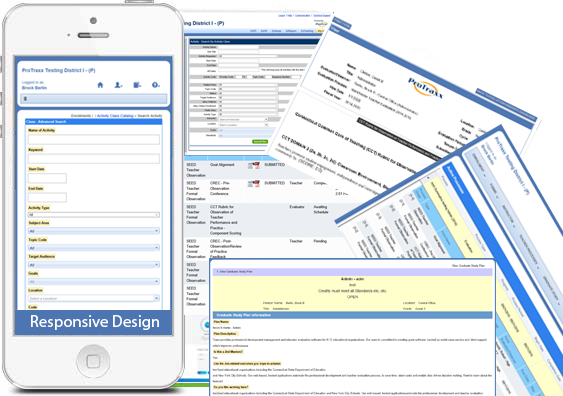
ProTraxx’s online PD workshops are hosted in our custom-designed learning management system, which seamlessly connects each district’s MyEzTraxx enrollment catalog to our online Moodle environment. Therefore, our online workshops will be available directly through your MyEzTraxx home page. Our staff will create and include the listing of all ProTraxx workshops for your online catalog. Each district can customize this data. Enrollment will be administrator or participant driven, and your staff can utilize their enrollment management page to view their enrollment status, complete their customized online evaluation form, and view their issued award.
Once the workshop or training has taken place, our certified instructors will access each district’s ProTraxx application to take attendance online and distribute your evaluation forms.
At this point, our instructors will also forward a summary results profile to your district. This profile includes information such as the names of the participants and all of their corresponding scores, reflective in their cumulative coursework portfolio.
District CEU Coordinators will then login to their EzTraxx application, and issue CEUs.
Because your district remains the service provider for these workshops, your EzTraxx application hosts all data associated with the workshops. Enhancing your data-driven decision making abilities is just one more unique benefit our online PD workshops offer!
Every workshop begins on the first of each month, and concludes three weeks later. Our online PD workshops will require at least 3-4 hours of participant time. Because each district is the service provider of these workshops, the time commitment is determined at your discretion. For instance, if districts would like to have participants share their final authentic activities with colleagues, or spend additional time researching provided resources, they can customize the workshop description and add that additional time commitment to the CEU issue amount. The price of the online workshop remains the same, but he CEU issue amount rests in the hands of each district.
Effective Teaching Strategies (Part One and Part Two)
In the
Art and Science of Teaching, Bob Marzano builds on his best selling book,
Classroom Instruction that Works, by reframing his nine effective teaching strategies
in terms of essential questions which represent a logical planning sequence for effective
instructional design. Each of our ETS workshops will examine one of Marzano’s instructional design questions, which integrate related effective
teaching strategies.
Research supporting each design question and effective teaching strategy will be reviewed,
as will the classroom application for each strategy. Participant comprehension will
culminate in their creation of a classroom activity which incorporates effective
teaching strategies. This activity will be scored via a rubric by our instructor.
Classroom scenarios, classroom work samples, make-it, take-it activities, and additional
resources are supplied to participants.
The essential questions that will be driving the this PD workshop are:
- What are effective teaching strategies?
- Why do we need to incorporate effective teaching strategies?
- How do we incorporate effective teaching strategies in our classroom environment?
Effective Teaching Strategies: Part One
Marzano’s Instructional Design Question 1 – “What will I do to establish and communicate learning
goals, track student progress, and celebrate success?” is the focus of this workshop.
The effective teaching strategies (1) setting goals/objectives and providing feedback and (2)
reinforcing effort and providing recognition will be explored in detail, guided by the below
questions:
- i. What is meant by establishing and communicating learning goals, tracking student progress, and celebrating success?
- ii. Why should we establish and communicate learning goals, track student progress, and celebrate success?
- iii. How do we establish and communicate learning goals, track student progress, and celebrate success?
Effective Teaching Strategies: Part Two (builds on the ETS foundation developed in Part One)
Marzano’s Instructional Design Question 2 – “What will I do to help students effectively interact with new knowledge?” is the focus of this workshop. The effective teaching strategies (1) summarizing and note taking, (2) nonlinguistic representations, (3) cooperative learning, and (4) questions, cues, and graphic organizers will be explored in detail, guided by the below questions:
- i. What is meant by helping students effectively interact with new knowledge?
- ii. Why should we help students effectively interact with new knowledge?
- iii. How do we help students effectively interact with new knowledge?
Differentiated Instruction: (Part One and Part Two)
This two-part workshop explores the theory and practice of differentiation, focusing on five powerful planning elements greatly impacting the ability to carefully and purposefully plan for differentiated instruction – climate, knowing your learner, instructional strategies, assessment, and planning and management.
Three essential questions will be guiding this interactive workshop:
- What is differentiated instruction?
- Why do we need to differentiate instruction?
- How do we differentiate our instruction?
Differentiated Instruction: Part One explores the definition of differentiation and the purpose for providing differentiated instruction. The impact that educational climate and knowing your learner have on the ability to differentiate classroom content, process, and product is studied in great detail, as are the three characteristics of students which guide differentiation - readiness, interest, and learning profile. Strategies for addressing differentiation are provided in the format of Teacher Tips, and sample lesson plans, templates, and resources are provided for both planning components.
Differentiated Instruction: Part Two builds on the foundation created in Part One, supplying additional instructional and assessment strategies, and planning and management techniques that support differentiated instruction. Teacher tips, including lesson plans, templates, and additional resources, are provided for each planning component.
Parent-Teacher Communication & Student Motivation
During this online professional development workshop, participants will examine the role motivation plays in determining student success. Participants will explore the concept that in order to achieve academic competency, students must be motivated to engage with tasks and to improve their proficiency levels. The use of various motivational strategies, such as increasing parent-teacher communication, and classroom instruction and practice which provide the support and feedback necessary for students to gain competence, will be studied.
The essential questions that drive this workshop are
- What motivates and engages students to excel?
- How do we incorporate these types of opportunities into our classroom environment?
Research supporting the theory of motivation will be explored, as will classroom application. Participant comprehension will culminate in their creation of a classroom activity incorporating motivational strategies. This activity will be scored via rubric by our instructor. Templates, sample activities, and resources will be supplied to the participants. All work will be goal driven and standards-based.
Multiple Intelligences in the Classroom
This online professional development workshop supplies participants with the knowledge and tools to unlock the hidden talents our students possess. Through researching and applying Howard Gardner’s theory of multiple intelligences, participants will hone their skills of fostering their students’ love for learning, self-esteem, self-motivation, and intellectual empowerment. Participants will gain a deeper understanding of the theory of multiple intelligences, its educational framework, and explanation of diversity. As the ability of participants to support their students’ individual growth and development is enhanced, their repertoire on diversifying instruction will continue to build.
The essential questions that drive this workshop are
- What is the theory and educational framework of multiple intelligences?
- How can utilizing multiple intelligences in my classroom instruction and practice enhance student learning?
- What are some ways that I can integrate the MI theory into my teaching and learning environment?
Research supporting the theory and educational framework of multiple intelligences will be explored, as will classroom application. Participant comprehension will culminate in their creation of a classroom activity incorporating multiple intelligences. This activity will be scored via rubric by our instructor. Templates, sample activities, and resources will be supplied to the participants. All work will be goal driven and standards-based.
PowerPoint in the Classroom
During this online professional development workshop, participants will discover and unleash the power of PowerPoint. The focus of this workshop is the integration of PowerPoint into the teaching and leaning environment as a method of increasing student motivation and addressing their unique needs. Participants will review the theories of multiple intelligences, diverse learning styles, and effective teaching strategies. Participants will then seamlessly incorporate this knowledge into creating effective and engaging PowerPoint instructional activities, such as presentations, maps and webs, interactive lessons containing video and audio, and student templates. Participants will also explore helpful hints for computer lab sessions that provide tiered levels of student assistance (establishing support teams, utilizing hotlists to direct and scaffold student learning, providing students with hard-copy tutorials, completed work samples, etc.) which help create a foundation for a successful learning experience for all.
The essential questions that drive this workshop are
- What does the successful integration of technology into the classroom curriculum look like?
- How can I utilize PowerPoint to address my students’ unique needs and support their growth and achievement?
Research supporting the benefits of technology integration will be explored, as will classroom application. Participant comprehension will culminate in their creation of a classroom activity incorporating PowerPoint. This activity will be scored via rubric by our instructor. Templates, sample activities, and resources will be supplied to the participants. All work will be goal driven and standards-based.
Data-driven Decision Making
The interdependent concepts of teamwork, data, and goals will be the primary focus of this workshop. Participants will gain a more cohesive understanding of how to maximize the use of data through effective team¬work and the setting of meaningful student achievement goals. The powerful role data can play in guiding instruction, supporting differentiated instruction, and improving student learning will be explored. Participants will learn how to successfully collect and analyze data, enhancing their ability to identify existing learning gaps, determine the causes for those learning gaps, and successfully address those learning gaps. This use of assessment data and its link to accountability will be studied and incorporated into the final authentic activity, in which participants analyze their student performance data for the purpose of establishing and achieving clear, measurable goals.
The essential questions that drive this workshop are
- What is the relationship between teamwork, data, and goals?
- How can data-driven decision making enhance my classroom instruction?
Research supporting data-driven decision making will be explored, as will classroom application. Participant comprehension will culminate in their creation of an authentic activity in which participants will analyze their student performance data for the purpose of establishing and achiev¬ing clear, measurable goals. This activity will be scored via rubric by our instructor. Templates, sample activities, and resources will be supplied to the participants. All work will be goal driven and standards-based.
Paraprofessional Training
Enhancing the unique relationship between teachers and instructional paraprofessionals is the focus of this online workshop. The partnership between a teacher and paraprofessional can greatly impact the classroom environment, allowing for a more thorough and effective teaching and learning environment. This workshop will enhance the ability of participants to maintain open communication, allowing their relationship with the classroom teacher to thrive. Participants will explore the documentation “Standards for a Profession”, produced by the Paraprofessional and School-related Personnel Division of the American Federation of Teachers. Participants will review the defined roles and responsibilities of instructional paraprofessionals, supporting their ability to “cement their connection to the role of the classroom teacher” (foreword). Participants will review the importance of consultation, collaboration and making joint decisions, and sharing information and tasks. By strengthening the partnership between teachers and paraprofessionals, teachers, paraprofessionals, and, most importantly, students, will all reap the benefits.
The essential questions that drive this workshop are
- What are my roles and responsibilities as an instructional paraprofessional?
- How can I strengthen my partnership with classroom teachers?
Research supporting instructional paraprofessional roles and responsibilities, and the partnership between paraprofessionals and teachers will be explored, as will classroom application. Participant comprehension will culminate in the creation of an authentic activity in which participants will analyze their current roles, responsibilities, and relationships, and establish and achieve clear, measurable goals of improvement. This activity will be scored via rubric by our instructor. Templates, sample activities, and resources will be supplied to the participants. All work will be goal driven and standards-based.
Literacy across Disciplines
During this online professional development workshop, participants will gain insight into research which supports that teacher integration of literacy-related instructional strategies facilitates student learning across all content areas. Because students must be able to read a variety of informational texts and produce written documents in order to experience success across the curriculum, through this workshop, participants will be provided with tools essential for successful integration of literacy strategies into diverse content areas. Participants will review a variety of literacy-related instructional strategies (ex. Question-Answer Relationships, Directed Reading-Thinking Activites, Definition Maps, Comparison Matrixes, Think Alouds, etc.) that greatly augment content-area learning. By the conclusion of this workshop, participants will be able to locate web-based tools, literacy-related instructional strategies, and sample lessons which enhance student literacy skills in all content areas.
The essential questions that drive this workshop are
- What are the most effective literacy-related instructional strategies for my students?
- At what point(s) during the learning process do I incorporate literacy-related instructional strategies?
- How do I incorporate literacy-related instructional strategies into my classroom environment?
Research supporting literacy-related instructional strategies will be explored, as will classroom application. Participant comprehension will culminate in their creation of an authentic activity in which participants will incorporate literacy-related instructional strategies into a lesson plan and reflect on the teaching and learning impact. This activity will be scored via rubric by our instructor. Templates, sample activities, and resources will be supplied to the participants. All work will be goal driven and standards-based.
online workshop hours
Every workshop begins on the first of each month, and concludes three weeks later. Each of ProTraxx’s online PD workshops will require at least 3-4 hours of participant time. Because each district is the service provider of these workshops, the time commitment would be determined at their discretion. For instance, if districts would like to have participants share their final authentic activities with colleagues, or spend additional time researching provided resources, they can customize that workshop and add that additional time commitment to the CEU issue amount.
benefits
- Anytime, anywhere online learning
- Authentic-based learning experiences culminating in activity development, submission, and rubric scoring
- No time away from the classroom
- No substitute coverage necessary
- Enhanced accountability for administrators and staff
- Cumulative coursework portfolio developed by each participant and shared with district administrators in a user-friendly monthly summary results profile report.
- Access to professional learning communities
- Video/audio presentations
- Online journaling
- Enrollment via MyEzTraxx catalog
- One-on-one instruction and interaction
- Growing offerings of online PD workshops based on district requests and current educational philosophy trends
- District hosting of PD workshops
- Downloadable files in PDF format
- Make-it-Take-it activities and templates available for download
technical requirements
Because ProTraxx’s online PD workshops are hosted in our custom-designed learning management system online environment, participants simply login to their MyEzTraxx site, requiring only Internet access and an email address.
Contact information
Danielle Salina
Director of Online Learning
ProTraxx
442 Smith Street
Middletown, CT
Phone: (860) 632-8821 ext. 122
Email: dsalina@protraxx.com
Web Site: www.protraxx.com